Tourist Tax Per Person or Per Room in 2026
14/04/2026
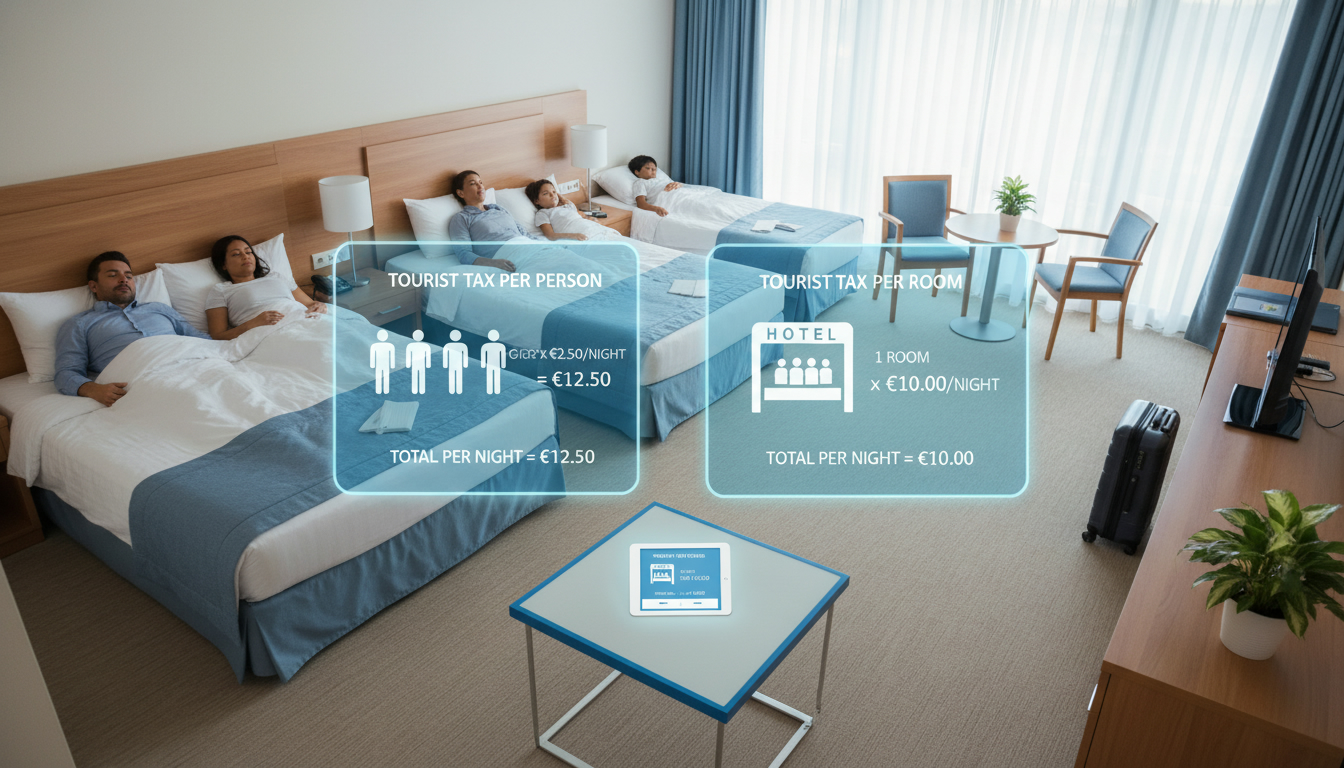
In short, what you will discover in this article: the essential distinction between the tourist tax per person or per room, how it is calculated, its impacts depending on the type of accommodation, as well as exemptions and legal obligations. You will thus be able to precisely anticipate the amount to budget for your stay.
1. Why the question "tourist tax per person or per room" is important
Understanding whether the tourist tax is calculated per person or per room is crucial to accurately estimate your vacation budget. Indeed, this distinction directly affects the final amount to be paid. Depending on the method used, a family, couple, or group may see their bill vary significantly. This also helps avoid unpleasant surprises at payment and better plan the stay.
Moreover, the tourist tax varies depending on municipalities and accommodation types, which can sometimes complicate understanding. This article guides you step-by-step to master these rules and anticipate the real cost of your accommodation.
2. What is the tourist tax?
2.1 Definition and legal framework
The tourist tax is a local contribution payable by tourists not residing in the municipality where they stay. It applies to paid accommodations such as hotels, campsites, tourist rentals, bed and breakfasts, etc. The amount is set by municipalities according to a national scale based on the nightly rate excluding tax and the accommodation category.
This tax aims to finance tourist infrastructure and local promotion. It is collected by the host or the accommodation platform and passed on to the local authority.
2.2 Who is liable? (hosts, tourists, etc.)
The tourist tax is due by each person accommodated, except for exceptions such as minors in some municipalities. The collector is the host, who must charge it and remit it to the town hall. For rentals through platforms like Airbnb, these intermediaries often collect the tax directly from travelers.
Thus, the vacationer pays the tax, but the host or platform manages its collection and declaration.
3. Calculation methods: tax per person vs tax per room
3.1 Definition of tax per person
The tourist tax per person is calculated by multiplying a fixed rate by the nightly stay and by each person accommodated. For example, in a 2-star hotel, the rate may be €0.90 per night per person. For a 3-night stay with 3 adults, the tax will be: 3 × 3 × €0.90 = €8.10.
This method is the most common and allows adjusting the tax precisely according to the number of guests present.
3.2 Definition of tax per room
The tax per room, also called flat-rate tax, is applied based on the accommodation’s capacity regardless of the actual number of people. For example, a furnished rental might be taxed according to the number of rooms or the maximum capacity, with a fixed amount per night.
This method simplifies management for some hosts but can be less fair for small groups or short stays.
3.3 Advantages and disadvantages of each method (for the municipality and the host)
-
Tax per person:
- Advantages: fairer, reflects actual attendance, optimizes revenue for the municipality.
- Disadvantages: more complex management, requires precise tracking of occupants.
-
Tax per room:
- Advantages: administrative simplicity, easier calculation for the host.
- Disadvantages: can penalize small groups, less flexible.
3.4 Comparative numerical examples (couple, family, group, long stay)
| Situation | Tax per person (€/night) | Tax per room (€/night) | Total for 3 nights |
|---|---|---|---|
| Couple (2 persons) | 2 × €1.00 = €2.00 | €3.00 | €6.00 vs €9.00 |
| Family (4 persons) | 4 × €1.00 = €4.00 | €3.00 | €12.00 vs €9.00 |
| Group (6 persons) | 6 × €1.00 = €6.00 | €5.00 | €18.00 vs €15.00 |
| Long stay (10 nights, 2 persons) | 2 × €1.00 × 10 = €20.00 | €3.00 × 10 = €30.00 | €20.00 vs €30.00 |
These examples illustrate that the tax per person is often fairer, especially for small groups or long stays.
4. Practical cases according to the type of accommodation
4.1 Hotels and bed & breakfasts
In hotels and bed & breakfasts, the tourist tax is usually calculated per person per night. The amount varies according to the establishment’s category and municipality. For example, a 3-star hotel may apply a higher tax than a rural bed & breakfast.
4.2 Vacation rentals and platforms (Airbnb, etc.)
For vacation rentals, the tax can be either actual (per person) or flat-rate (per accommodation). Platforms like Airbnb often collect the tax automatically. The calculation depends on the accommodation’s classification and local rules.
4.3 Campsites and youth hostels
Campsites also apply the tax per person, sometimes with a specific rate for pitches. Youth hostels, which often welcome groups, may benefit from particular provisions, but the general rule remains tax per person.
5. Exemptions and special situations
5.1 Minors, seasonal workers, long stays, humanitarian cases
Certain categories are exempt, notably:
- Minors in several municipalities.
- Seasonal workers on assignment.
- Long stays (more than 90 days).
- Humanitarian cases or specific situations.
5.2 How to apply exemptions (supporting documents, registration)
To benefit from an exemption, you must provide proof to the host (ID card, work contract, etc.). The host must then adjust the declaration and tax payment.
6. Administrative obligations for professionals
6.1 Collection, record keeping, remittance, and declaration
The host must:
- Collect the tax from guests.
- Keep an accurate record of nights and persons.
- Declare and remit the tax to the town hall within deadlines.
6.2 Risks, inspections, and penalties in case of non-compliance
Non-payment or incorrect declaration exposes to financial penalties and inspections. It is therefore essential to respect the rules to avoid sanctions.
7. Commercial impact and practical recommendations
7.1 How to include the tax in the displayed price (pricing strategies and transparency)
To avoid surprises, it is advisable to clearly state whether the tourist tax is included in the displayed price or not. Transparency reassures customers and eases booking.
7.2 Setting up booking tools/PMS and client communication
Hosts must configure their booking tools to automatically calculate the tax according to the chosen method. Clear communication on invoices and websites is recommended.
8. Tools and resources
8.1 Downloadable calculator/simulator
To simplify calculation, you can use online simulators adapted to local rules. These tools quickly estimate the tax amount based on the number of people and duration.
8.2 Templates of notices and FAQs to display
It is useful to display legal notices on your site or accommodation concerning the tourist tax, its methods, and exemptions to inform your clients.
9. Conclusion
The tourist tax per person or per room depends on the calculation method chosen by the municipality and accommodation type. The per person method is the most frequent and fair, while the flat-rate tax per room simplifies management. To properly prepare your vacation budget, it is essential to check local rules and request an exact calculation from your host. To deepen your knowledge on living costs while traveling, you can consult our comprehensive article on the cost of living in Palma de Mallorca.
[1] For more details on calculation methods and a concrete example, see the article from Capital.fr.

Marine Lefèvre
Passionnée par le tourisme alternatif et l'hébergement chez l'habitant, je m'intéresse depuis plusieurs années aux échanges authentiques entre voyageurs et hôtes. Forte d'une expérience concrète dans la mise en relation et l'accueil participatif, j'accompagne aussi bien les visiteurs que les particuliers qui souhaitent offrir une chambre ou un logement. Mon expertise me permet de dédramatiser les démarches administratives et de clarifier les attentes pour une cohabitation harmonieuse. Sur BienvenueChezNous, je partage des conseils pratiques et des retours d'expérience pour guider chacun vers une immersion conviviale et réussie, tout en apportant des réponses simples et accessibles.